It's worth making a good person great. Not a bad person good.
One of the best lessons I learned as a manager came when I was working for Nick Lazaridis at AMD. I’ve shared this tidbit with pretty much every manager I’ve managed since, and I hope Nick doesn’t mind me sharing his wisdom here.
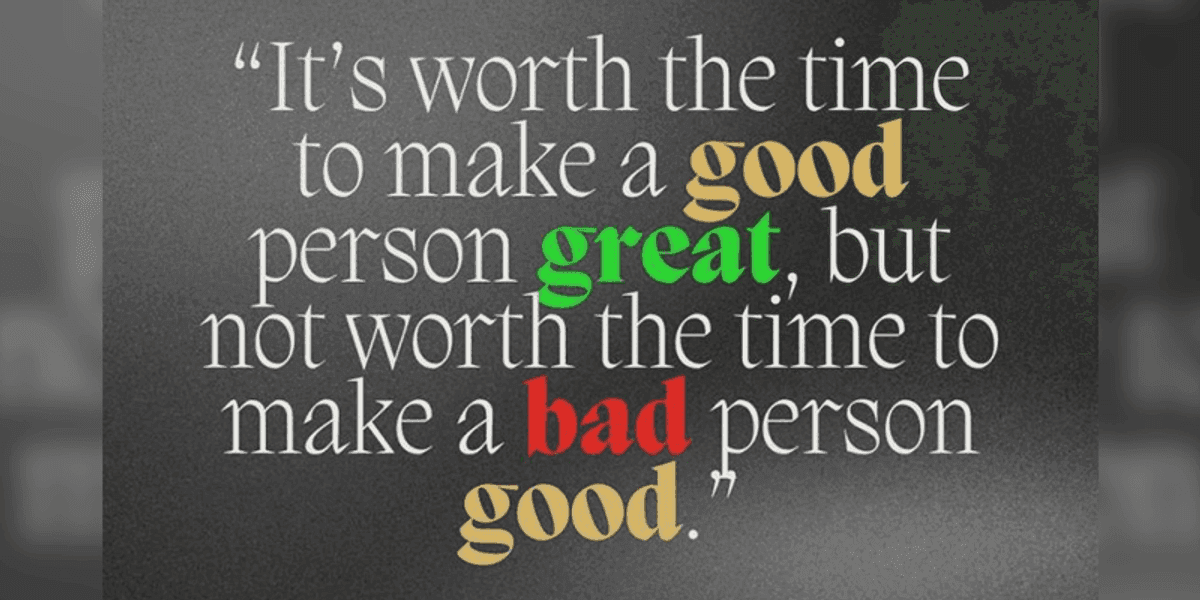
The line is: “It’s worth the time to make a good person great, but not worth the time to make a bad person good.”
When Nick shared this with me, my initial reaction was shock. Isn’t it the job of managers to make their team the best they can be?
The answer is yes - but the issue is that some people are simply in the wrong role for their skill set. That’s why so much of effective leadership training and team development training is about placing people where their natural abilities can shine, rather than forcing them into roles where they’ll always struggle.
By taking the time to move poor performers from the “bad” to “good” column, you’re often increasing their ability to perform in a role where their ceiling is limited, if the improvements even stick at all. Employees struggling in the wrong role may improve with maximum effort, but the moment that effort slips, performance drops again.
If they were naturally “good” in a role, that same investment of time could make them “great” - driving their careers forward and creating stronger teams. This is why team building isn’t about pushing everyone in the same direction, but about aligning strengths so each person contributes where they can have the biggest impact.
So instead of spending all your energy trying to max someone out at “good,” invest in finding them a role where their baseline strengths already fit well. Encourage them to focus on moving from “good” to “great.” Much better to run fast with the wind at your back than to gain little ground running full force against it. This principle also applies in our leadership escape room training: when teams experience the immersive challenge of an escape room Singapore setting, they quickly learn that success comes from leaning into each profile’s natural strengths, not forcing someone into the wrong role.
This is a valuable lesson for individuals, too. Later in my career, I found myself in an assignment where things just didn’t click, and I could recognize I was a poor fit for the task. I was “bad,” fighting to reach “good.” I discussed this with the team, swapped assignments, and moved on to new tasks that let me grow from “good” to “great.”
Sometimes, the lessons that sound the harshest are actually filled with the most compassion. True leadership training Singapore programs - whether in the classroom, the office, or in an escape room training environment - are about helping people discover where they can thrive, and then giving them the chance to grow from there.
You might also like reading this:

Everybody Gets Stuck Sometimes
What’s your reset ritual? In those moments when everything feels off, what does it take to flip the switch and get back into the swing of things? On a recent Friday morni...

Sales Systems in The Age of AI
As a startup cofounder, it was interesting to watch the recent selloff in software stocks, driven by the idea that AI is coming for them. Trust me, I get it. When we star...

Announcing... Racing for Results!
It’s time to launch our latest product ! Come join our first public demo! Racing for Results is our newest, immersive workshop, which teaches about difficulties caused by...
Difficulties of Entrepreneurship
One of the things I have been thinking about a lot lately is how difficult it is to explain what entrepreneurship feels like when you are inside of it. From the outside,...

Career Journey after FAANG
The company cultures of the FAANG companies and those of their generation have changed over the past 1015 years, and we’re seeing veteran employees no longer aligned with...